


































How can one’s religion encourage a balanced approach to spiritual health?
Spiritual health has gone largely unnoticed when it should actually be worth mentioning. It is very important that in a global survey, done by Mckinsey.com, a majority of respondents said spiritual health is “extremely” important to them.
Spiritual health is very essential and has a close connection to religion, or as it says in a study formed by the National Alliance on Mental Illness(NAMI):“Both religion and spirituality can help a person tolerate stress by generating peace, purpose and forgiveness.” Spiritual health and religion are settled in trying to display the meaning of life. Religion would be defined as a system that carries off beliefs or rituals that a community has, meanwhile, spiritual health inhabits within an individual’s beliefs. But what obstacles can you go-through with poor spiritual-health? According to a study released by Catholic Stand, it is revealed that a poor spiritual health is most likely to increase your anger, make you more impatient and bring bad habits that can derange your life.
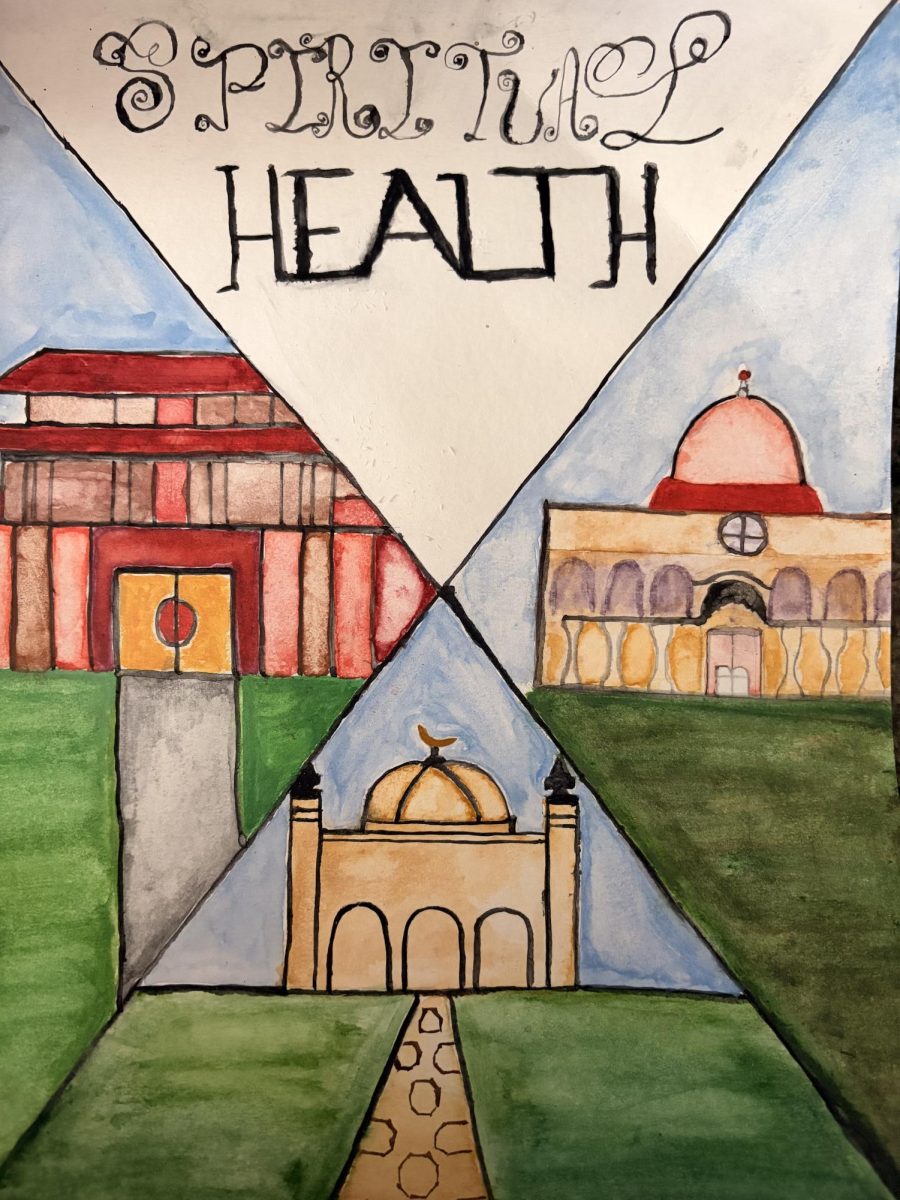
New York is shaped with different religions, each with a deep connection in their spiritual health; Spiritual health is all about bringing to light your purpose in life, and this can be done easier with the help of religion— they each have their own spiritual practices.
ISLAM
Tina Fofana, a 15 year old born into a family of Muslims, attends high school in the Bronx. She dedicates herself to a daily routine of prayer at dawn, noon, mid-afternoon, sunset, and night. Religion plays a very big part in her identity, as she expresses herself. “It defines your identity through your relationship with Allah by providing a sense of purpose for understanding right from wrong and following God’s path of teaching.”
Religion can be an important foundation for many people’s lives; with religion you have hope, with hope you have faith and with faith you have a sense of purpose. Tina is a very devoted Muslim who wears her hijab as a way of representation. They believe that Alláh, their god, will always pay attention and place them in the “right path.” This path is what will lead them to having a balanced spiritual life. Tina believes that spiritual health is all about maintaining a pure, clean and rich body.
BUDDHISM
Buddhism is another religion that takes spiritual health as an important factor. They believe that human beings have the potential to become free from suffering—Nirvana—by practicing meditation and cultivating a lifestyle that’s mentioned by the Buddha;the awakened one. Buddhism is a major religion that was founded during the 6th century BCE, in India. But it soon turned into more than just a single religion, according to Tricycle.org. It mentions that throughout the centuries, Buddhism has grown into three main branches—including Theravada, Mahayana, and Vajrayana. But there is no big difference between them because they still share core beliefs such as: Karma, mindfulness, and compassion.
Mahayana Buddishm—“great vehicle”— takes on many great teachings such as:
- Four Noble Truths, which are the truths understood by someone who is noble or awakened, this is the path to buddhahood.
- The Eightfold Path, which represents the 4th truth in the Four Noble Truths.
The practice of Buddhism causes people to feel joy, the joyness in acknowledging the dharma—Buddhist teachings—and allowing it to connect you to a much more spiritual liberation.
Ven Rumu is a teacher at the Mahayana Temple, located at 133 Canal Street in New York. Starting at the age of 10, Ven Runu would volunteer with his mother at the temple. While this was what led to his conversion to Buddhism, it simultaneously led to some obstacles that challenged his faith.
“The primary obstacles in practice are bridging the gap between knowing and doing, and the realization that it is far easier to advise others than it is to discipline oneself.”
Ven Rumu reveals an obstacle that not only Buddhists go through but many other religious people–though he himself was influenced by his master Chan Master Hui Men.
As mentioned already, Buddhists believe that in order to achieve a well balanced spiritual life, you must attain enlightenment. And to help others attain it, benefits both of you. But Ven Rumu has so much more to accomplish as a teacher.
“ At the invitation of ESBT, I serve as a teacher at Mahayana Temple to help students unlock their own inherent Prajna (transcendental) wisdom, ensuring that the Chan Dharma spreads and remains to bring joy and benefit to all.”
With their own beliefs comes their own definition for spiritual health, as seen before, Tina F–a muslim– has her own definition for spiritual health; she mainly focuses on keeping the body rich, clean, and pure. However, Ven Rumu being a Buddhist defines it in a different way. “To give rise to the mind that seeks nothing; to seek nothing while using the mind.”
Understanding the meaning of this phrase requires not thinking too much, rather than just letting it flow into your mind and allowing it to take control. That way you may gain inner peace. In Buddhism you meditate a lot, with your mind seeking nothing but deep mental stillness.
JUDAISM
Judaism is another early-born religion, coming into existence over 4,000 years ago in the middle east. According to Jewishstudies.washington.edu, the word “Jew” was not used as a way to identify one-self, instead they would use the term “sons-and-daughters-of Israel.” Judaism has its own sacred scripture also known as the Tanakh—an abbreviation for its three main sections: The Torah(teaching), Nevi’im(prophets) and Ketuvim(writings). Their core beliefs consist of one single God—not Jesus Christ—and they’re waiting for a Messiah to come.
In order to obtain a balanced spiritual health in Judaism, you follow a tradition that’s called “sh’mirat haguf ,” guarding the body. This tradition is very well known in giving instruction as to how to care for your body, physically. According to reformjudaism.org, it is important for someone to maintain a healthy body because only then will someone be able to fulfill the mitzvot— commandment/obligation — and sacred actions that are done in Judaism.
Lexington (Lexi) Lewis is a 15 year old, attending high school in Manhattan. Though her parents were not Jewish, she was converted when she was a baby. Lexi believes that religion is a great way to strengthen your spiritual health.
Did you know that when someone dies, instead of saying “Rest in Peace,” Jewish people say “May their Memory be a blessing?” Lexi explained. “We think it’s better to focus on their life than their death.”
Lexi is a devoted Jew who takes spiritual health very seriously. She labels her religion as her “lifestyle,” which simultaneously means that Judaism is a part of her identity.
“There’s a lot of, like, kind of things that it’s very, like, worked into my lifestyle because of my Jewish background. Like, specifically, we kind of honor life as much as death, and, you know, and we try to celebrate a lot of people’s life and, like, what they go through, but also we still try to acknowledge the suffering.”
The beauty of someone being part of a religion is the ability to feel or see something incredible.
Religion can be seen in many different ways; whether it’s a cultural tradition, a social guide, etc. However, after going around asking people about their religion, it is clear that religion is a way to cope, a way to have a more balanced spiritual health. Spiritual health is an important key factor for many religions because it serves as an accomplishment. It serves as a useful guide in order to obtain a better life.