










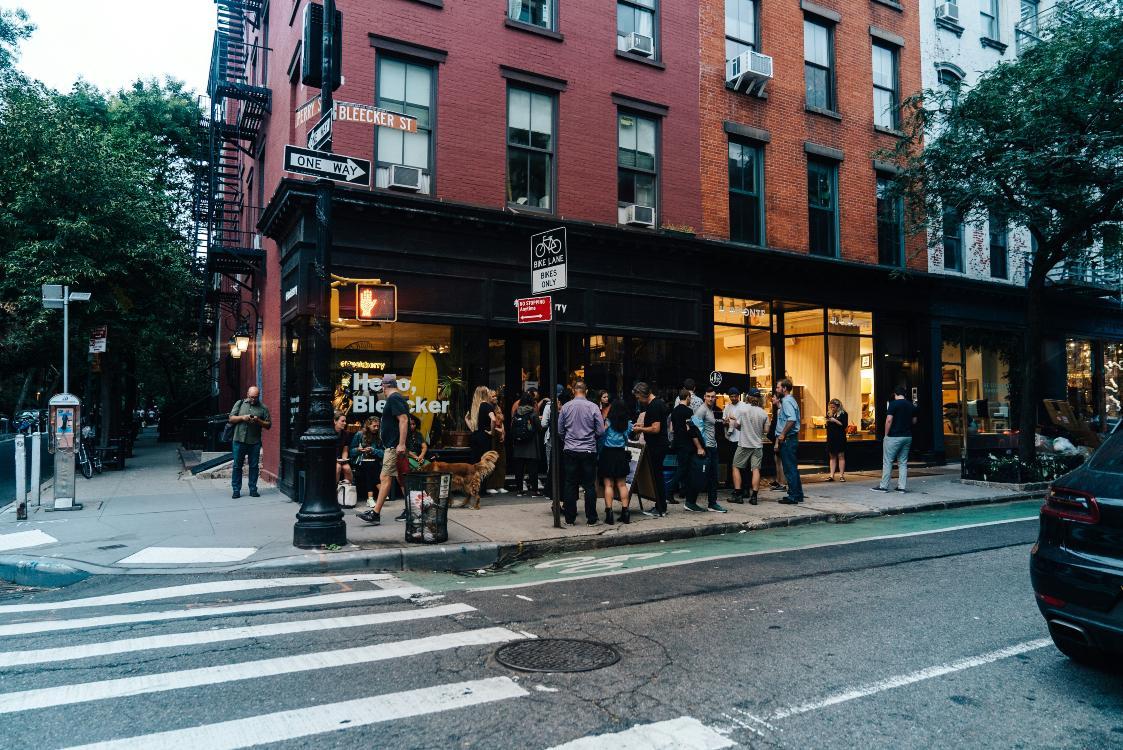
Imagine yourself walking by a line stretching down the block for a viral Manhattan café, then seeing tourists hold up their phones to film pastries they first saw on TikTok. However, just a few subway stops away, you also see family-owned restaurants serving generations of authentic cuisine sit nearly empty.
Why is this the case when NYC is considered one of the world’s best food capitals? Every restaurant follows general operations with staff, unique menus, and a general goal of satisfying customers. But in reality, one major factor today determines how successful a restaurant becomes: how well it is marketed on social media.
On social media, you’re constantly bombarded with viral pizza shops, fast food chains like Chipotle, and influencer-famous restaurants like Sugar Factory. Algorithms tend to push the same places repeatedly because of their popularity, strong online presence, and aesthetic appeal. Over time, this creates a narrowed version of what New York City food actually is.
For us New Yorkers, we are far more likely to be exposed to food videos in NYC simply because we live in New York, where these trends are happening in real time and constantly reinforced online. In fact, studies show that more than half of consumers have visited a restaurant after seeing it on social media, highlighting just how powerful these platforms are in shaping where to dine.
Due to this, tourists often end up experiencing a limited version of NYC food culture, by dining in at mostly viral or heavily marketed spots. Tourists miss out on family-owned restaurants, unique cultural fusion foods like Guyanese-Chinese dishes, and affordable local eateries that rarely show up online.
Tourists’ Perspective
Many tourists rely heavily on social media when deciding where to eat in NYC.
Anna Mozzon, a tourist visiting from Spain, said most of her restaurant choices came from social media. “I was most excited to try the various fast food chains like Raising Cane’s and Shake Shack…I didn’t know any other typical foods of the city, so I would say fast food chains along with a select few pizza places.”
Godfred Kyeremeh, a tourist from Alabama, also said social media influenced his choices. “I dare say that I enjoyed the pizza in Germany and Ghana more than New York,” he contradictively said. He also mentioned that some of his decisions were based on personal interest rather than NYC culture, like trying Paris Baguette because he likes “foreign stuff.”
Regardless, both tourists show the same pattern: they weren’t really aware of authentic NYC food spots outside what was already trending online.
Locals’ Perspective
From a local perspective, many New Yorkers feel tourists are missing out on the real food culture of the city.
William Yap, a New York local working in finance, said, “Most tourists are just going to the most overhyped places online, and they are missing out on the real soul of New York City food.” He explained that some of the best food in the city comes from cheap, hole-in-the-wall spots like noodle shops or dumpling places under ten dollars.
Yap also believes neighborhoods outside Manhattan have some of the best food scenes, especially places like Sunset Park and Bath Beach in Brooklyn.
Kris Singh, a New York local and a recent graduate of Hofstra University, also believes that many tourists are only experiencing the commercialized version of NYC food culture rather than what actually represents the city. “A lot of the places there I’d say are mainly overhyped or built for the tourist diaspora, which isn’t necessarily the New York, authentic feel,” Singh said.
He explained that New York City food culture cannot simply be reduced to pizza slices or trendy cafés because of the amount of cultures and cuisines throughout the city. “There’s so many different cultures, so many different foods that you can tap into,” he said. Singh especially pointed toward neighborhoods outside Manhattan, such as Bay Ridge in Brooklyn, where visitors can experience Yemeni, Syrian, and Lebanese cuisines all within one community.
Additionally, Singh believes that tourists often remain concentrated in Manhattan because those are the areas most advertised online and built around tourism. “They’re going to be in regions that are sort of built for tourists, which are going to be overpriced and not necessarily the New York feel,” he explained.
Instead, Singh encourages visitors to explore neighborhoods outside Manhattan in order to experience NYC more authentically. “There’s a lot of culture outside of Manhattan,” he said. “If you’re coming to New York to try out this food culture, venture out to parts of Brooklyn, parts of the Bronx, and parts of Queens to really get a feel of a lot of the cultures that make up this city.”
Restaurant Owner’s Perspective
Located near the heart of Manhattan Chinatown, Golden Diner is known for its Asian-American twist on diner food, especially its honey butter pancakes. Sam Yoo, the owner, explained that social media plays a big role in bringing attention to his restaurant.
According to Yoo, many customers discover restaurants online before ever coming to New York. “They get their interest by social media,” he said. “That’s when they first really have an interest in coming.” He also noted that people often post their experiences online afterward, which helps spread the restaurant’s reach even more.
However, he also pointed out that social media alone isn’t enough. “It’s not just about social media,” he explained. “Because if it was just social media…and the food or the experience wasn’t great, then people would spread that word too.”
He also mentioned that many neighborhoods outside Manhattan don’t get enough attention even though they have really strong food scenes.
From tourists, locals, and restaurant owners, it becomes clear that no one is necessarily at fault. Social media has simply become one of the biggest ways people discover food today, helping certain restaurants gain massive attention while others remain overlooked.
But it also creates a problem: tourists don’t get the full picture of NYC food culture. They end up seeing what’s viral, not necessarily what’s authentic or most representative of the city.
As Sam Yoo explained, social media may spark someone’s interest in a restaurant, but the actual experience is what matters most. In the end, NYC food culture is much larger than what appears on a For You Page, with many of the city’s most authentic restaurants existing outside the spotlight of social media.