




Every year, tens of thousands of books are banned from the shelves of children. These texts are removed due to ‘harmful’ themes of injustice, violence, oppression, hardship, etc. In some cases, these themes are deemed morally ‘inappropriate’ due to the ideas which they may invoke in children, such as being part of the LGBTQIAP+ community, or standing up against racism. While protecting children from unsuitable themes can be justified, it is when books are instead banned under the false belief that they contain unsafe themes that we must rise up and take action.
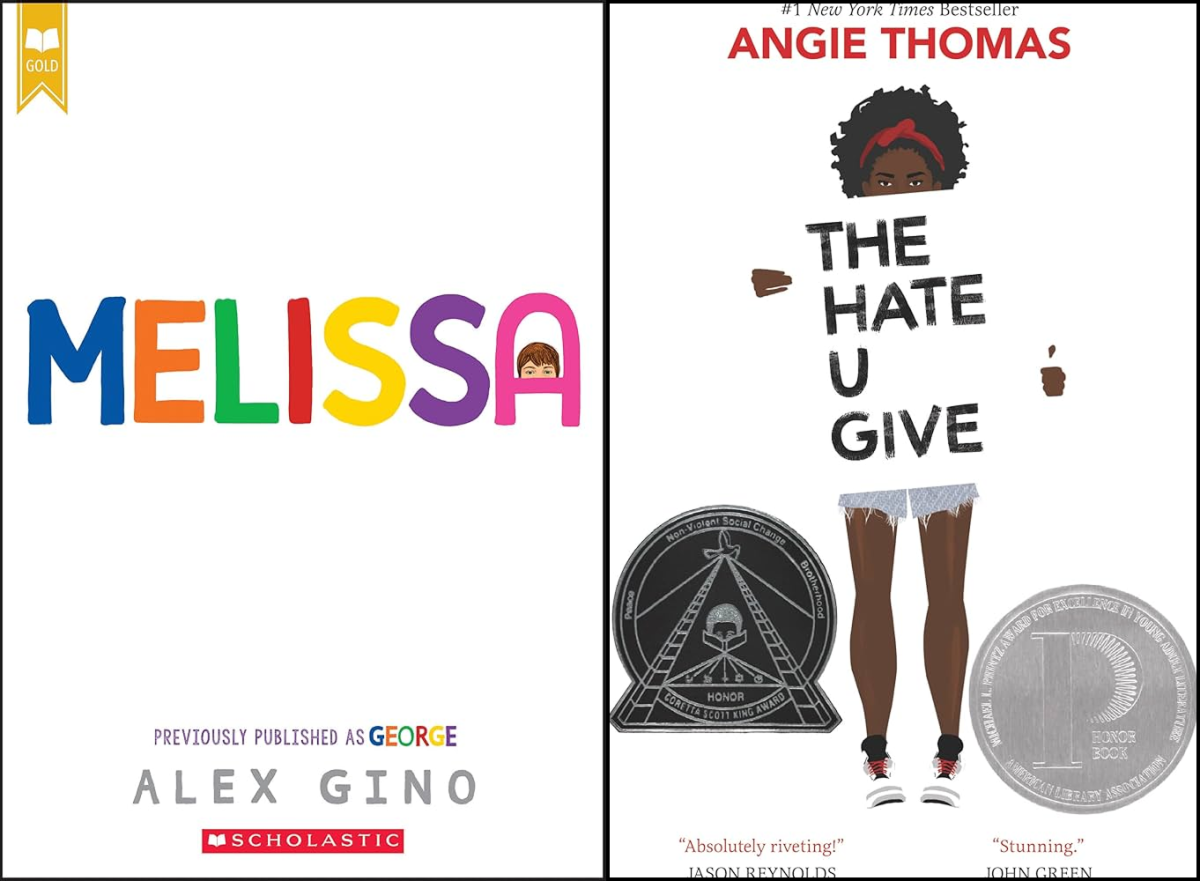
Pieces of literature such as Melissa (formerly known as George) by Alex Gino, or The Hate U Give by Angie Thomas reflect such ‘harmful’ themes. Melissa tells the story of a transgender girl who expresses her experience of oppression and hardship while coming out. Meanwhile, The Hate U Give reveals themes of racism and inequality as 16 year old Starr Carter fights for justice for her friend who was unfairly killed. Both texts demonstrate realistic yet socially labeled ‘wrong’ experiences in our modern society, thus appealing to children who are attempting to understand the world around them. However, both Melissa and The Hate U Give have appeared on PEN America’s most frequently banned books list over the past few years.
As children are developing, they become heavily dependent on the perspectives they are initially exposed to. Their minds have not yet witnessed the political or societal influence of the “adult world,” and it is therefore entirely up to them what they deem to be ‘right’ or ‘wrong,’ Thus, the issue that arises here is one of limitation: when children aren’t exposed to a variety of perspectives due to book banning, we narrow their perspectives into one we wish them to have. “You start to only see things, or only get information from one side, and that can really impact your world view. That’s not what democracy is about,” says Fritzi Bodenheimer of the Brooklyn Public Library.
While the First Amendment protects American access to literature, school administrators and parents have the right to ban certain books. However, in many instances, these books are not banned out of the need to protect students, but the need to expose them to more ‘correct’ ideas. Elders attempt to prevent children from developing abstract opinions, which have traditionally been silenced.
Still, as Bodenheimer notes, “What we can’t allow is for someone who says, “I don’t like that book for my children” to take it {the book} off the shelf so no one else can read it.” Unfortunately, in the U.S. alone, hundreds of thousands of children continue to be impacted by banned books each year.
When this occurs, a child is forced to develop a world view based solely on what they’ve been told – because nothing else is out there. The children become carbon copies of the people before them. When you rip a child from choice, they default to the choices of those around them. It is for this reason that beliefs will rarely vary between generations.
As more and more books are continuously banned, we must remember what these books provide children: opportunity. We must put aside our own beliefs for the sake of the next generation and what they decide to be morally ‘right’ or morally ‘wrong.’ If we allow them to develop their own opinions, we can move towards a society where those opinions work in harmony to eliminate common issues. We cannot ban books because of our own fear – instead, it is that fear which must keep those books on our shelves.